
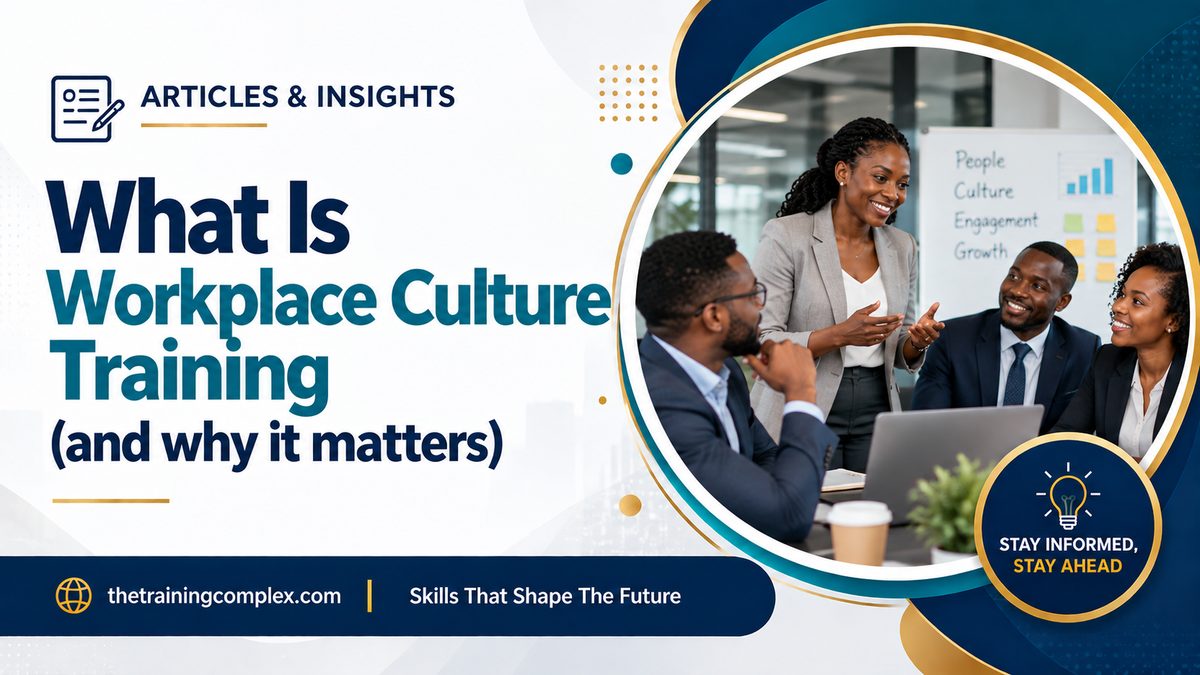
Workplace culture training is one of those terms that gets used frequently in HR circles but rarely gets the precise definition it deserves. At its core, it refers to structured learning programmes designed to help employees and leaders understand, reinforce, and actively shape the values, behaviours, and norms that define how an organisation operates day to day. Done well, it is far more than a one-off induction session — it is an ongoing, strategic investment in how your people work together.
Defining Workplace Culture Training
Culture is not the ping-pong table in the breakroom or the mission statement on the wall. It is the sum of how decisions get made, how conflict is handled, how success is celebrated, and how failure is discussed. Workplace culture training equips employees at every level with the awareness and practical skills to participate constructively in that environment — and, crucially, to help improve it.
This type of training typically encompasses several interconnected areas:
Why Workplace Culture Training Matters More Than Ever
Organisations that neglect culture do not have no culture — they simply have an unmanaged one. Left unaddressed, poor cultural norms compound over time: disengagement spreads, high performers leave, and the cost of replacing talent quietly erodes profitability. According to research from Gallup, companies with highly engaged workforces outperform their peers by 23% in profitability — and engagement is inseparable from culture.
The post-pandemic shift to hybrid and remote working has made this even more pressing. When teams rarely share a physical space, culture cannot be absorbed passively. It has to be taught, practised, and reinforced intentionally. Workplace culture training provides exactly that structure.
The Business Case: What Organisations Actually Gain
Executives sometimes treat culture as a soft concern — something important in principle but hard to justify on a balance sheet. In reality, the returns are concrete and measurable.
Reduced Turnover
Employees who feel their workplace culture aligns with their own values are significantly less likely to seek roles elsewhere. Culture training helps surface and close the gap between stated values and lived experience — the gap that quietly drives attrition.
Stronger Collaboration Across Teams
Shared frameworks for communication and behaviour reduce friction between departments. When everyone understands the expected standards of interaction, cross-functional projects move faster and with less interpersonal friction.
Improved Customer Experience
Internal culture almost always becomes external reputation. Teams that are psychologically safe, engaged, and well-led tend to deliver more consistent, more empathetic service to clients and customers — particularly in high-contact service environments.
Risk Reduction
Organisations that invest in culture training — particularly around inclusion, respect, and ethical conduct — are better insulated against the reputational and legal risks that come with workplace misconduct. Prevention is considerably less costly than remediation.
What Effective Workplace Culture Training Looks Like
The most effective culture training programmes share a few common characteristics. First, they are leadership-led, not just HR-delivered — when senior figures visibly participate and model what is being taught, the message carries real weight. Second, they are sustained over time rather than delivered as a single event; behavioural change requires repetition and reinforcement. Third, they are contextually relevant — generic off-the-shelf modules rarely shift deeply held norms. The most impactful programmes are tailored to an organisation's specific challenges, industry pressures, and growth stage.
Finally, they measure outcomes. Whether through employee engagement surveys, 360-degree feedback, or retention metrics, strong programmes create feedback loops so organisations can see what is working and where adjustment is needed.
Ready to Strengthen Your Workplace Culture?
Workplace culture training is not a remedial measure reserved for organisations in crisis — it is a proactive strategy that high-performing businesses use to sustain their edge. Whether you are building culture from scratch in a fast-growing team, navigating a merger, or working to close the gap between your values and your employees' daily experience, the right training can create lasting, measurable change.
At TrainingComplex Institute, our corporate culture and leadership programmes are designed to do exactly that — combining evidence-based frameworks with practical application so your people leave every session equipped to act differently, not just think differently. Explore our range of workplace culture and professional development programmes to find the right fit for your organisation.