
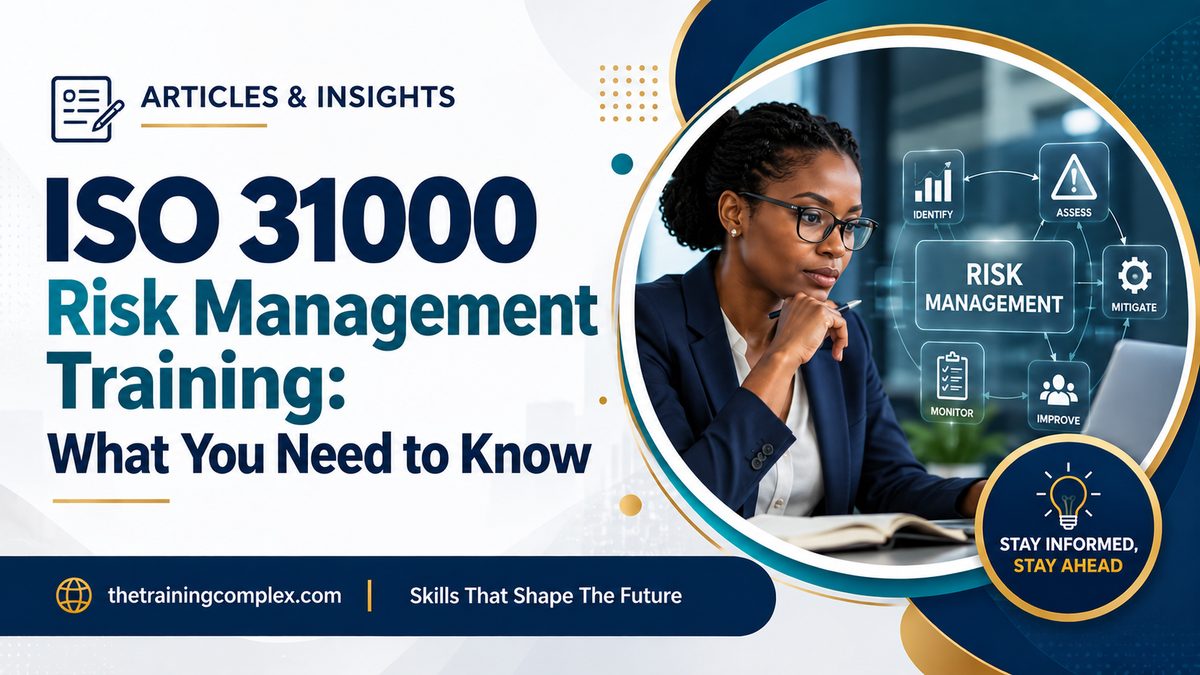
Organisations that manage risk well don't just avoid disasters — they make better decisions, allocate resources more effectively, and build stakeholder confidence. ISO 31000 risk management training gives professionals the conceptual framework and practical tools to do exactly that, grounded in the world's most widely adopted risk management standard. Whether you're building a risk function from scratch or looking to formalise existing practices, understanding what this training involves is the right place to start.
What Is ISO 31000 and Why Does It Matter?
ISO 31000 is an international standard published by the International Organization for Standardization that provides principles, a framework, and a process for managing risk across any organisation — regardless of sector, size, or industry. Unlike prescriptive compliance standards, ISO 31000 is deliberately flexible. It doesn't tell organisations exactly what to do; it establishes a coherent, structured approach that can be adapted to specific contexts.
The standard was last updated in 2018, introducing a stronger emphasis on leadership commitment, integration of risk management into organisational decision-making, and a more iterative, dynamic process model. These updates reflect how modern organisations actually operate — in fast-moving, interconnected environments where risk is not a one-time assessment but a continuous consideration.
What ISO 31000 Risk Management Training Covers
A well-structured ISO 31000 training programme will typically move through several interconnected areas:
- Core principles: Understanding the eleven guiding principles of the standard, including that risk management should be integrated, structured, inclusive, and dynamic.
- The risk management framework: How to design, implement, evaluate, and continually improve the organisational structures that support risk management — from leadership mandate to resource allocation.
- The risk management process: The step-by-step process of communication and consultation, scope and context setting, risk identification, risk analysis, risk evaluation, risk treatment, monitoring, and review.
- Risk appetite and tolerance: How organisations define acceptable levels of risk and translate those definitions into operational guidance.
- Integration with strategy: Positioning risk management not as a compliance function but as a strategic enabler that supports better planning and more confident decision-making.
Who Should Attend ISO 31000 Training?
The standard's broad applicability means training draws professionals from a wide range of functions. Risk managers and internal auditors are obvious candidates, but so are operations leaders, project managers, finance professionals, and senior executives who need to understand and champion risk management across their organisations.
ISO 31000 risk management training is particularly valuable for:
- Professionals transitioning into dedicated risk or compliance roles
- Team leaders responsible for operational or project risk
- Executives and board members seeking governance-level fluency in risk concepts
- Consultants advising clients on enterprise risk management
Because the standard is non-sector-specific, participants from financial services, manufacturing, healthcare, government, and technology all find the content directly applicable to their work.
Certification and Learning Outcomes
Training programmes aligned with ISO 31000 typically offer foundational or practitioner-level pathways. A foundational course builds conceptual understanding of the standard — its structure, vocabulary, and intent. Practitioner-level training goes further, developing the skills to design and implement a risk management framework, conduct risk assessments, and report findings meaningfully to leadership.
By the end of a quality programme, participants should be able to:
- Explain the principles and intent of the ISO 31000 standard with confidence
- Map their organisation's existing risk practices against the standard's framework
- Lead or contribute to a structured risk identification and assessment process
- Develop risk treatment plans that are proportionate and actionable
- Communicate risk information clearly to both technical and non-technical stakeholders
Practical Application Over Theory
The most effective ISO 31000 training programmes balance conceptual grounding with real-world application. Look for programmes that use case studies, workshop exercises, and scenario-based assessments — these approaches help participants translate the standard's language into decisions and processes they can act on immediately after training.
Ready to Strengthen Your Organisation's Risk Capability?
ISO 31000 risk management training is one of the most transferable investments a professional or organisation can make — because sound risk thinking improves outcomes across every function and every level of decision-making. At TrainingComplex Institute, we offer structured risk management programmes designed for working professionals, with a focus on practical application and real organisational impact. Explore our risk management training portfolio to find the programme that matches your role, your industry, and where you want to take your career.