AI workplace skills training in 2026 is no longer a forward-looking conversation — it is an urgent operational priority. Across industries, artificial intelligence is automating routine tasks, accelerating decision-making, and fundamentally changing what employers expect from their people. The question organisations are grappling with is not whether AI will affect their workforce, but how quickly they can equip their teams to work alongside it effectively.
The Skills Gap AI Is Creating Right Now
The rapid adoption of AI tools — from generative platforms like large language models to predictive analytics dashboards — has exposed a widening skills gap that traditional training programmes were not designed to address. According to the World Economic Forum's Future of Jobs Report, more than 60% of workers will require significant upskilling before 2027, with analytical thinking, AI literacy, and complex problem-solving topping the list of in-demand competencies.
What makes this shift particularly challenging for HR and L&D leaders is its breadth. The impact is not confined to technical roles. Customer-facing teams, finance departments, operations managers, and even senior executives are encountering AI-driven workflows that require a new baseline of digital and cognitive fluency.
What AI Workplace Skills Actually Look Like in Practice
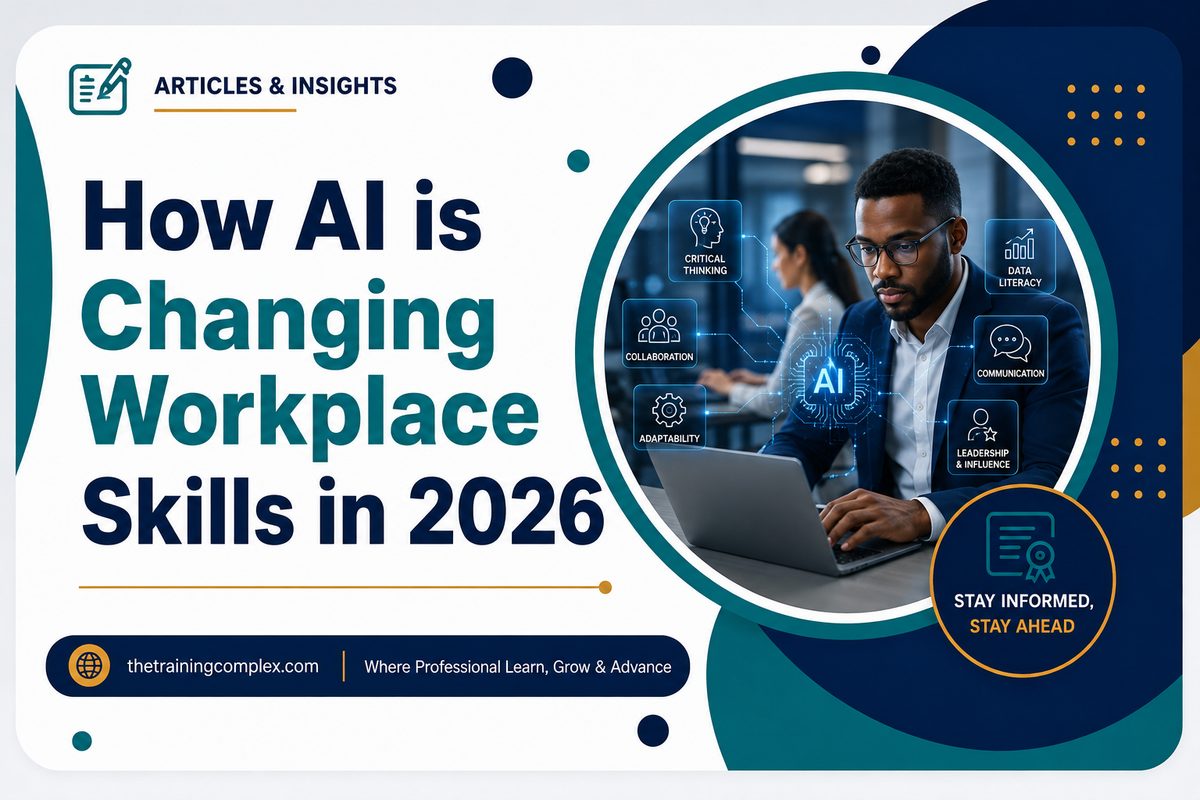
When we talk about AI workplace skills, it is tempting to default to coding or data science. In reality, the competencies that matter most for the majority of employees are far more accessible — and far more urgent to develop:
- AI literacy: Understanding what AI tools can and cannot do, how they generate outputs, and where human judgement remains essential.
- Prompt engineering and tool fluency: The practical ability to interact effectively with AI platforms — crafting clear inputs, evaluating outputs critically, and integrating tools into existing workflows.
- Data interpretation: Reading AI-generated reports and dashboards with enough confidence to make informed decisions rather than simply deferring to algorithmic recommendations.
- Ethical and critical reasoning: Recognising bias in AI outputs, understanding data privacy obligations, and applying sound judgement where automated systems fall short.
- Adaptability and continuous learning: Perhaps the most durable skill of all — the willingness and capacity to keep pace with tools and processes that are themselves constantly evolving.
Why Soft Skills Have Never Mattered More
One of the more counterintuitive findings from organisational research in recent years is that the rise of AI has increased the premium on distinctly human capabilities. As machines take over repeatable, rules-based tasks, skills like empathy, creative thinking, stakeholder communication, and ethical leadership become genuine competitive differentiators.
This has significant implications for corporate training strategy. Organisations that invest only in technical upskilling — and neglect the interpersonal and leadership competencies that AI cannot replicate — risk building a workforce that is tool-proficient but strategically shallow. The most resilient employees in 2026 are those who combine AI fluency with strong critical thinking and collaborative skills.
How Organisations Are Responding
Progressive organisations are moving away from one-off training events and towards continuous learning ecosystems that blend digital modules, facilitated workshops, and on-the-job application. Several practical approaches are gaining traction:
- Role-specific AI upskilling pathways — rather than generic AI awareness sessions, training mapped to specific job functions and the tools teams are actually using.
- Manager-led learning cultures — equipping team leaders to model AI-positive behaviours, facilitate peer learning, and identify emerging skill needs before they become performance gaps.
- Scenario-based learning — immersive exercises that place employees in realistic AI-augmented situations, building both confidence and critical thinking simultaneously.
- Measurement frameworks — tracking not just training completion, but behavioural change and business impact, so L&D investment can be justified at board level.
The Role of Leadership in Driving AI Readiness
No upskilling programme succeeds without visible leadership commitment. Senior leaders who actively engage with AI tools, champion learning initiatives, and communicate openly about the organisation's direction set the cultural conditions in which skill development can flourish. Conversely, organisations where AI adoption is driven from the top down — without genuine investment in employee capability — tend to see resistance, disengagement, and underwhelming returns on their technology spend.
Leadership development programmes are therefore increasingly incorporating AI strategy, change management, and digital transformation literacy as core components — not as optional add-ons, but as central to what effective leadership looks like in 2026.
Build the Skills Your Organisation Needs for What Comes Next
The pace of AI-driven change shows no sign of slowing, and the organisations that thrive will be those that treat AI workplace skills development as an ongoing strategic investment rather than a one-time initiative. Whether you are looking to build AI literacy across your entire workforce, develop future-ready managers, or design a structured upskilling pathway for a specific function, the right training partner can make the difference between reactive catch-up and genuine competitive advantage. Explore TrainingComplex's range of corporate training programmes — designed specifically to help organisations develop the skills that matter most in a rapidly changing world of work.