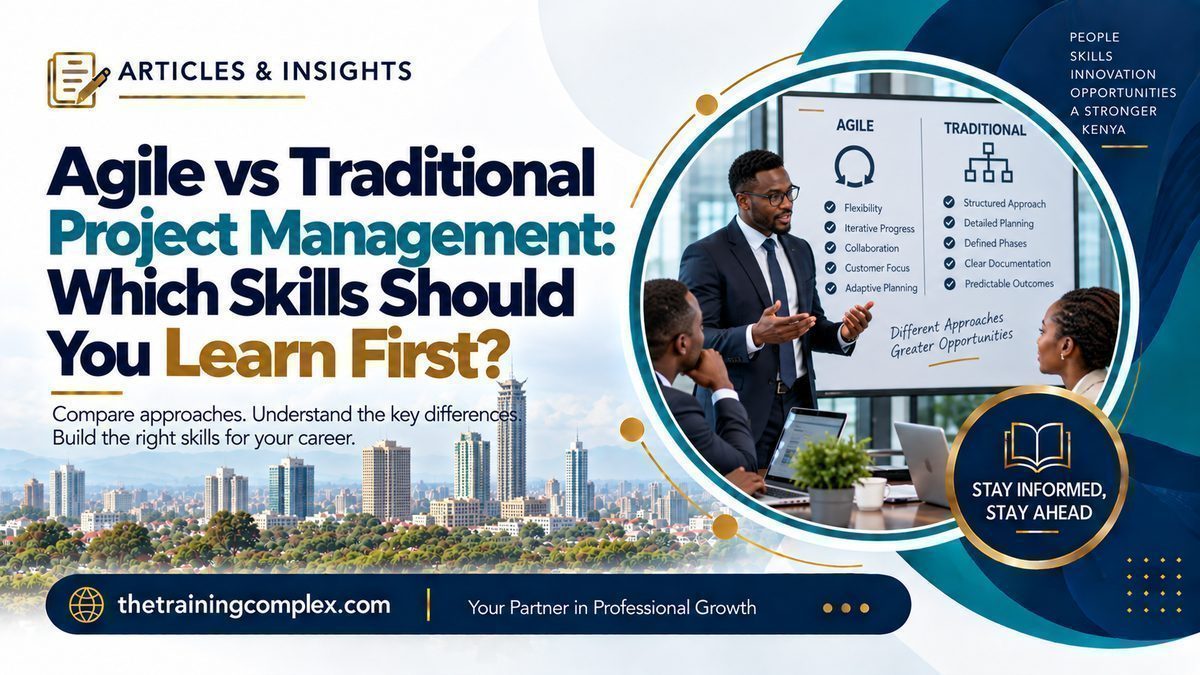
The debate around agile vs traditional project management isn't just an abstract methodology discussion — it's a very practical question for anyone planning their next professional development move. Whether you're a new project coordinator weighing your options or a seasoned manager looking to expand your toolkit, the order in which you build these skills can meaningfully affect your career trajectory and your immediate value to employers.
What We Mean by Traditional Project Management
Traditional project management — most commonly associated with the Waterfall model and underpinned by frameworks like PRINCE2 and the PMI's PMBOK — follows a linear, sequential structure. Requirements are defined upfront, phases are completed in order, and changes mid-project are formally controlled and often discouraged.
This approach excels in environments where scope is well understood, regulatory compliance is critical, or physical deliverables make iteration impractical. Construction, manufacturing, government infrastructure, and pharmaceutical development all tend to favour structured, plan-driven methods. The skills it demands — detailed planning, risk registers, stakeholder reporting, and earned value management — are rigorous and transferable across virtually every industry.
What Agile Actually Involves (Beyond the Buzzword)
Agile is frequently mischaracterised as simply
Ready to master IT Project Management and Agile Methodologies Training?Join our expert-led training and put it into practice.
Do I need to be a certified project manager to attend this course?
No formal certification is required. The course is designed for professionals with at least one year of experience in an IT environment, whether as a team member, analyst, or technical professional. It introduces both project management and agile frameworks comprehensively, so prior formal training is not a prerequisite.
Will I receive a certificate upon completing the course?
Yes. All participants who successfully complete the five-day programme will receive a TrainingComplex Certificate of Completion in IT Project Management and Agile Methodologies. This certificate is a recognised professional development credential suitable for inclusion in your CPD portfolio.
Does the course prepare me for PMP or Scrum Master certification?
This course provides strong foundational and intermediate-level knowledge aligned with both PMBOK and Scrum frameworks, making it excellent preparation for certifications such as PMP, PMI-ACP, or Certified ScrumMaster (CSM). However, it is not itself an examination-prep course, and separate study is recommended before sitting those exams.
What tools or software will be used during the training?
Participants will work with widely used IT project management and agile tools including Microsoft Project, Trello, and Jira during hands-on workshops. No prior experience with these tools is required, and all software used during training will be provided or accessible via browser.
Is this course available online for remote participants?
Yes. This programme is available as a Live Virtual cohort delivered via an interactive online platform, with the same facilitators, exercises, and materials as the in-person format. Remote participants engage in live sprint simulations, group workshops, and real-time discussions throughout the five days.