
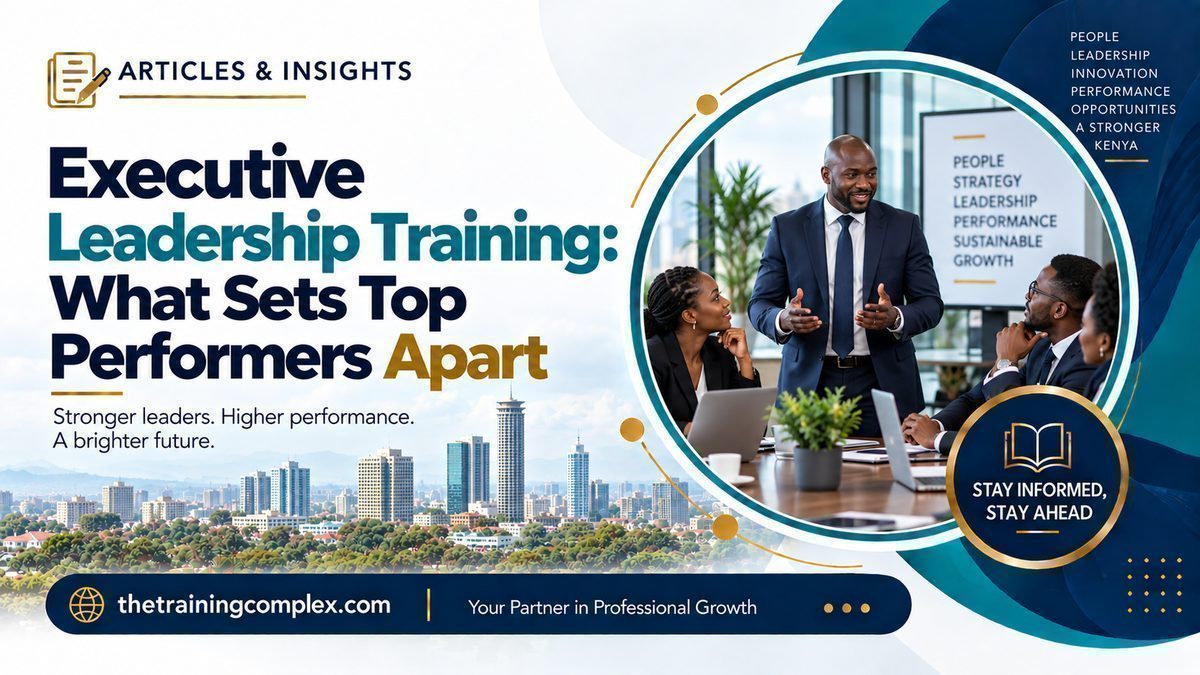
When organisations invest in executive leadership training, they are not simply sending managers on a course — they are making a deliberate decision to reshape how their senior talent thinks, communicates, and drives results. Yet not every leader who completes a programme emerges transformed. The difference lies in what separates high performers from the rest, and understanding that gap is the first step toward closing it.
The Mindset Shift That Defines Executive-Level Leadership
Most managers rise through the ranks by being exceptionally good at a technical discipline — finance, operations, sales, engineering. Executive leadership demands something different: the ability to zoom out from daily execution and think in systems, timelines, and stakeholder dynamics simultaneously.
Top performers in executive roles develop what researchers often call adaptive cognition — the capacity to hold ambiguity without anxiety, revise assumptions quickly when new information arrives, and make high-quality decisions under pressure. This is not an innate trait. It is a learnable skill, and structured training programmes that include real-world scenario work, peer challenge, and coached reflection are among the most reliable ways to develop it.
What Executive Leadership Training Actually Develops
The best programmes go well beyond communication workshops or personality profiling. They build a specific set of competencies that research and practice consistently link to senior leadership effectiveness:
The Habits That Separate Top Performers
Across industries, the executives who consistently outperform their peers tend to share a small number of well-documented habits. Crucially, these habits are not personality quirks — they are practices that can be taught, coached, and reinforced.
They seek feedback relentlessly
Average leaders tolerate feedback; top performers actively solicit it, even when it is uncomfortable. They build feedback loops into their regular routines — through peer review, executive coaching, 360-degree assessments, and honest conversations with direct reports. Executive leadership training programmes that embed structured reflection create the conditions for this habit to take root.
They invest in their networks strategically
High-performing executives understand that a strong internal and external network is not a social luxury — it is a competitive asset. They spend time maintaining relationships with peers in adjacent industries, thought leaders, and mentors who can offer perspectives that internal teams simply cannot provide.
They develop other leaders deliberately
One of the clearest markers of a top-performing executive is the quality of the leaders beneath them. The best senior leaders prioritise talent development not as an HR obligation, but as a core strategic function. They delegate with intention, coach for growth, and create psychological safety that allows their teams to take risks and learn from failure.
Why Formal Training Still Matters at the Senior Level
There is a persistent assumption that by the time someone reaches the executive level, they have learned everything they can from formal development. The evidence points firmly in the opposite direction. Senior leaders who participate in structured executive leadership training — particularly cohort-based programmes that include peer learning, expert facilitation, and applied projects — demonstrate measurably stronger strategic output and team performance than those who rely on experience alone.
Experienced executives bring a richness of context to formal learning that junior participants simply cannot. When a programme is well-designed, that context becomes an asset — both for the individual and for the wider cohort. Peer learning at the executive level is frequently cited as one of the most valuable elements of any senior development programme, because the diversity of experience in the room is itself the curriculum.
Ready to Develop Your Organisation's Executive Talent?
The qualities that define top-performing leaders — adaptive thinking, strategic influence, courageous decision-making, and a commitment to developing others — are not reserved for a rare few. With the right structure, challenge, and support, they can be developed systematically across your senior team.
TrainingComplex offers executive leadership training programmes designed for organisations that are serious about building leadership depth at every senior level. Whether you are preparing high-potential managers for their next step or investing in the continued development of your existing leadership team, our programmes are built around the competencies that research and practice show matter most. Explore our leadership development offering to find the right fit for your organisation.